
No bot can spend money on its own.
BrugBot is a multi-agent trading desk for memecoins and stocks. Twelve agents debate a token, an independent approver re-checks the decision from scratch with fresh data, and a separate vault manages the open position. Each part can only do its own job; the rules are tied to code, not to a model's good intentions.
- Signing key in only two containers
- No rule goes live without evidence
- One command stops all buying
- Interface in 7 languages
 Open the full-screen demo
How a buy happens
Every proposal passes through four separate hands. If any link in the chain says "no" or fails to answer, no trade is made.
Scan and risk gate
The desk gathers trending lists, the herald's themes and whale signals. Tokens with low liquidity, concentrated ownership, honeypots or open mint/freeze authority are dropped before any debate.
⌧ no keyDebate
Four analysts write reports, the bull and the bear argue, a referee decides. If the answer is "buy", the trader makes a plan, the risk team weighs it and the portfolio manager has the last word.
⌧ no keyApprover
Re-checks the proposal without trusting the desk: a fresh-data risk gate, budget and position limits, has the price run away, is there a quote? If a sceptical auditor model says "no", it's rejected.
⚿ signing keyVault
Tracks the approved position with reconciliation every minute; applies take-profit, stop-loss, time and inactivity exits. It can't buy, and it sleeps when no position is open.
⚿ sell only
The desk writes proposals but can't trade. The approver trades but can't write proposals. Trust comes from nobody being able to do everything.
The 12 agents at the desk
The debate graph comes from TauricResearch/TradingAgents; the memecoin analysts and the risk gate are ours. On every call each agent sees its own job card, the team chain and the latest lessons drawn by the student.
Analysts
- Chartprice and volume structure
- Walletownership and smart money
- Flownews and KOL flow
- Securitycontract and liquidity
Research
- Bullargues the buy thesis
- Bearargues the counter-thesis
- Refereesettles the debate
Risk team
- Aggressiveargues for the opportunity
- Neutrallooks for balance
- Cautiouslimits the loss
Execution
- Traderentry and exit plan
- Portfolio managerthe desk's final decision
With early decision on, if research says "hold" or "sell" the analysis ends there; the trader and risk team never run. Most analyses end at this point, saving minutes and model requests every time.
When the quota runs low, the desk can switch to light mode: only the chart and security analysts work and the risk team is skipped. Every analyst has a hard time limit; a stuck model doesn't hold up the analysis.
Opportunity hunters
The desk doesn't just watch the trending list. Separate containers listen to different corners of the market and a score model ranks the candidates; none of them can buy.
Herald
Regularly scans news and social themes; reports tokens that fit a narrative people are talking about to the desk, with a confidence score.
- KOL calls, smart-money buys, crypto news feeds, Reddit
- The model can't write a token address; it can only pick a row from the table
Whale watcher
Looks not at single big buys but at clusters where several smart wallets enter the same token together.
- Protection, distribution, liquidity and chasing checks
- Refreshes its list of accurate wallets every hour
- Chased clusters go into the Merchants' Guild ledger; if the price returns to the whales' average, the token goes to the desk
Collector
Takes snapshots of the market without spending model requests: trending lists, new tokens, signals, smart-wallet buys.
- Raw material for backtests; prevents survivorship bias
- A daily report every day
Score model
Without spending model requests, it learns each candidate's chance of winning from observations whose outcome is known. It only takes part in decisions for candidate groups where it has proven itself.
- The group's top 20% skip the desk and go straight to the approver, which still runs every check
- The weakest 40% never reach the desk; without proof, the score is only recorded
Rules enforced in code
These aren't left to a model's judgement; they're checked in the approver's code. Limits change in the settings file, the rule itself doesn't.
| Rule | What it does |
|---|---|
| Only a "buy" decision | The desk writes a proposal only on a Buy/Overweight decision. |
| Fresh risk gate | The approver recalculates risk with new data: liquidity floor, large-wallet share, honeypot and authority checks. |
| Size | Calculated with quarter Kelly from the hit rate of closed trades; it can only shrink the size the desk proposes. |
| Expected value | No buy until the expected value per unit invested clears the threshold. |
| Total risk | The total stop-loss exposure of open and new positions is capped at a small share of the bankroll. |
| Caps | Fixed upper limits per trade, per day and on simultaneously open positions. |
| Runaway price | Rejected if the proposal is stale or the price has risen noticeably since it was made. |
| Exit plan | Before every entry: a volatility-based stop-loss; take-profit at 2.5x the stop. A trailing stop that follows as profit grows, and timed take-profit targets that fall as time passes. Sell when time runs out or the price stalls. |
| Time machine | In live mode no trade opens until the strategy passes its thresholds on past decisions and in a 10,000-session simulation. |
| Fill check | In live mode the order's status and fill are read separately; an implausible fill value is not accepted, and a buy left unclear is checked again by the vault. |
| Castle gates | One command, or /dur on Telegram, stops all buying; /sat closes an open position by hand. |
A bot that measures itself
A strategy is only promoted with evidence. Gathering that evidence is the job of separate teams.
BrugBot Castle
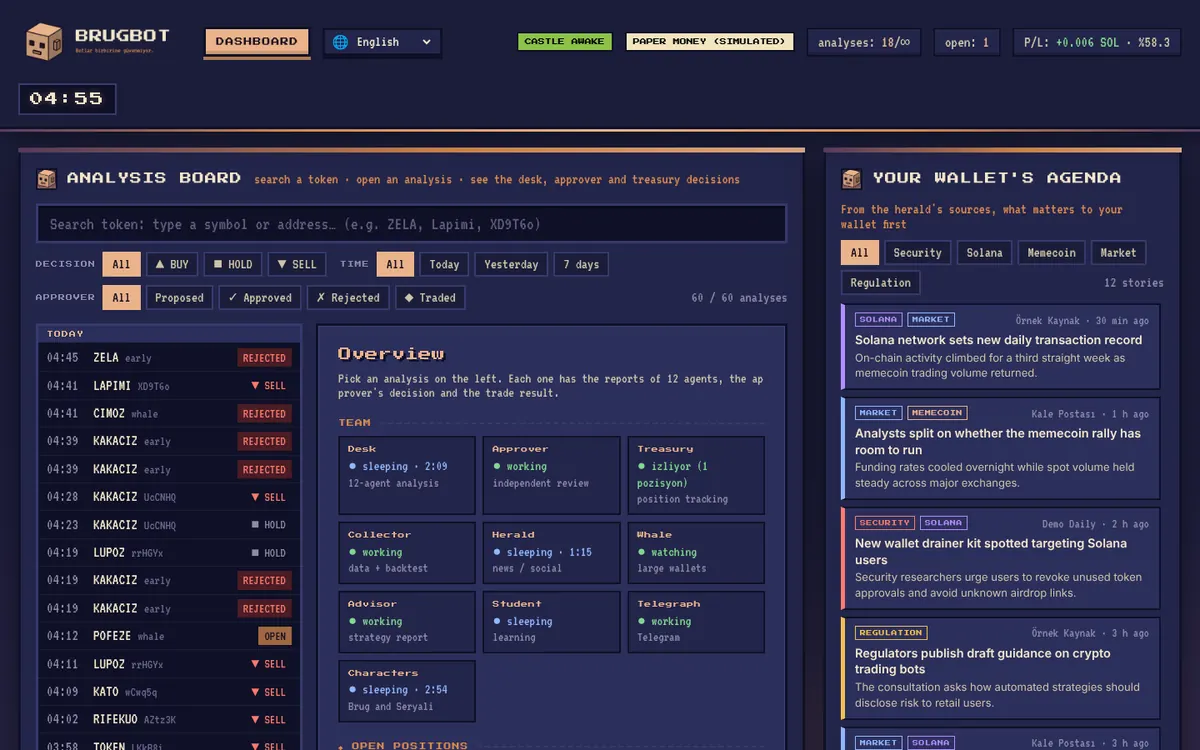
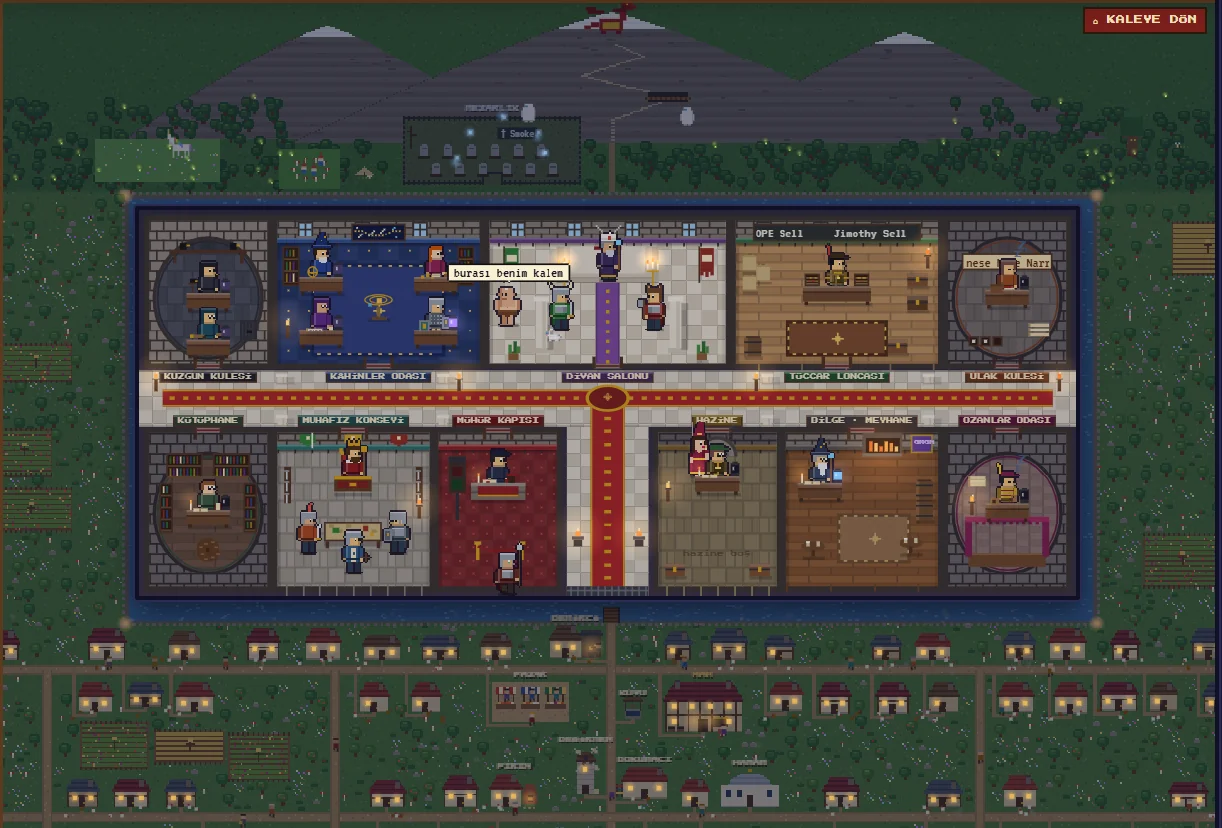
Instead of reading logs, you look at the castle. There are three views (analysis dashboard, 2D map and 3D kingdom), and the interface comes in seven languages; the screen only reads, sees no keys and can't give orders.
Search a token, open its analysis and see the desk's, the approver's and the treasury's decisions with their seals in one file. Filter by decision, time and approver status; list the executed ones separately. The roadmap section shows the score model's evidence status, the model mode and the daily request counters.
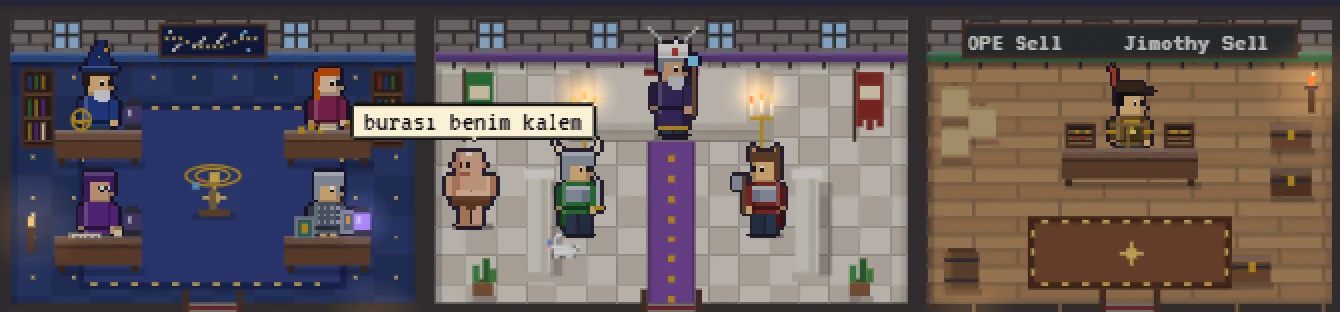
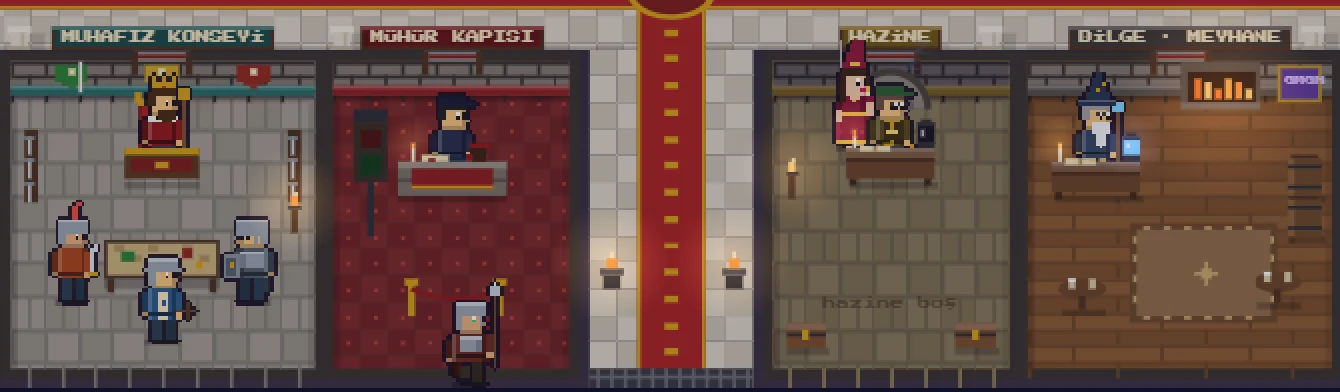
Every container is a room in the castle. Agents do exactly what they are really doing at that moment; a crashed room's door shows "CLOSED". In the 3D view the castle stands in the middle of a kingdom with coastlines, winding rivers and a dragon's lair.
Open positions, analysis count and profit/loss are always visible at the top of the screen; on the map, gold piles in the vault are open positions.
Proposals, approvals and rejections are logged in order with their reasons; you can see which check stopped what.
From the sources the herald scans, news about the tokens in your wallet comes first; the rest is sorted by region in the gazette.
When the emergency stop is on, the castle gates close and a red warning appears at the top of the screen.
The castle speaks seven languages
Switch the interface language with one click from the 🌐 menu in the top bar; your choice is remembered in the browser. Choosing Arabic turns the screen right-to-left. Only interface text is translated; reports, logs and news headlines written by the agents stay as they are. No extra model requests or costs.
- TRTürkçe
- ENEnglish
- ZH中文
- HIहिन्दी
- ESEspañol
- FRFrançais
- ARالعربية
Brug and Seryali. Two more characters live in the castle. Seryali walks the rooms motivating the team; Brug has no job, wanders around and makes odd comments about what's happening. Their lines are written by AI from the latest decisions and news themes, using very few requests. An X account for Brug is also in the works: one line a day; no token names, prices or links, and no model requests.
Technology
Built on open-source parts. Each container runs on its own and starts with its own task card. Every model request goes to free models; if a model is withdrawn, the next one in the chain takes over automatically. The paid fast model is locked in code and off by default. Which model answered and how long it took is recorded; the daily quota breakdown appears in the report and on Telegram via /kota.
- Python
- Docker Compose
- TauricResearch/TradingAgents
- virattt/ai-hedge-fund
- gmgn-cli
- Solana
- SQLite
- NVIDIA NIM
- OpenRouter
- RSS and Reddit
- Telegram Bot API
BrugBot is currently used only by our team; it is not a public service or a signal channel. Nothing here is investment advice. With memecoins, losing all your money is common.